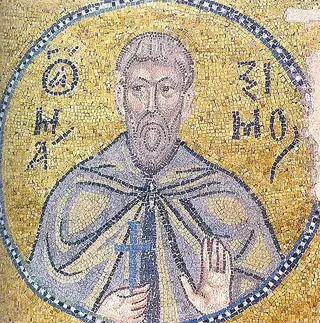
Maximus was born about 580. A Greek Life makes him a nobleman of Constantinople and a secretary of the emperor Heraclius; a hostile Syriac Life places his birth in Palestine. About 614 he became a monk at Chrysopolis, across the Bosporus from the capital. When the Persians overran Asia Minor he fled west and settled near Carthage, where he learned from Sophronius, later patriarch of Jerusalem.
To win back those who rejected the Council of Chalcedon, the emperors proposed that Christ has only one activity and one will. Maximus answered that a nature without its own will is not a whole nature: if the Son did not take a human will, he did not heal ours. In 645 he debated the former patriarch Pyrrhus at Carthage, and in 649 he helped Pope Martin I prepare the Lateran Council that condemned the new teaching.
Maximus the Confessor in the library (3 works)
- Maximus the Confessor: Letter to Marinus — c. 645–646; translation 2026
Maximus's letter to a priest of Cyprus on two complaints against a pope's letter: that the Spirit proceeds "also from the Son", and that Christ as man was free of the ancestral sin. Our own translation from the Greek, al - Maximus the Confessor: Mystagogy — c. 628–630; translation 2026
Maximus's explanation of the church building and the rites of the divine Liturgy as symbols of God, the world, man and the soul, and of the mysteries of salvation, after the teaching of a 'blessed elder'. Our own transla - Maximus the Confessor: Four Hundred Chapters on Love — c. 626; translation 2026
Four hundred short chapters, in four 'centuries', on the love of God and neighbour, the passions, dispassion, prayer and the knowledge of God, gathered by Maximus from the Fathers for the monk Elpidius. Our own translati